

Making Knowledge Visible
Building Community
Facilitating Computational Action
Connected Spaces (CxS) is a learning design framework made of a toolkit and a curriculum designed to support meaningful making practices and connect students—especially those underrepresented in STEM+C—to peers and mentors across distance. Through these connections, we aim to boost students' sense of belonging and identity as makers, and inspire greater interest in pursuing STEM+C careers.

This material is based upon work supported by the National Science Foundation under Grant Numbers #2048852 & #2048833.
The CxS Framework

Making Knowledge Visible
CxS aims to make students' identities and learning processes visible, fostering a sense of belonging to an extended community of makers.

Building Community
CxS aims to provide the conditions to create collaborative communities by promoting social connections, technical support, and mentorship even at a distance.

Facilitating Computational Action
CxS strives to provide diverse access points to computing and making by fostering digital empowerment and computational identity.

The CxS Toolkit
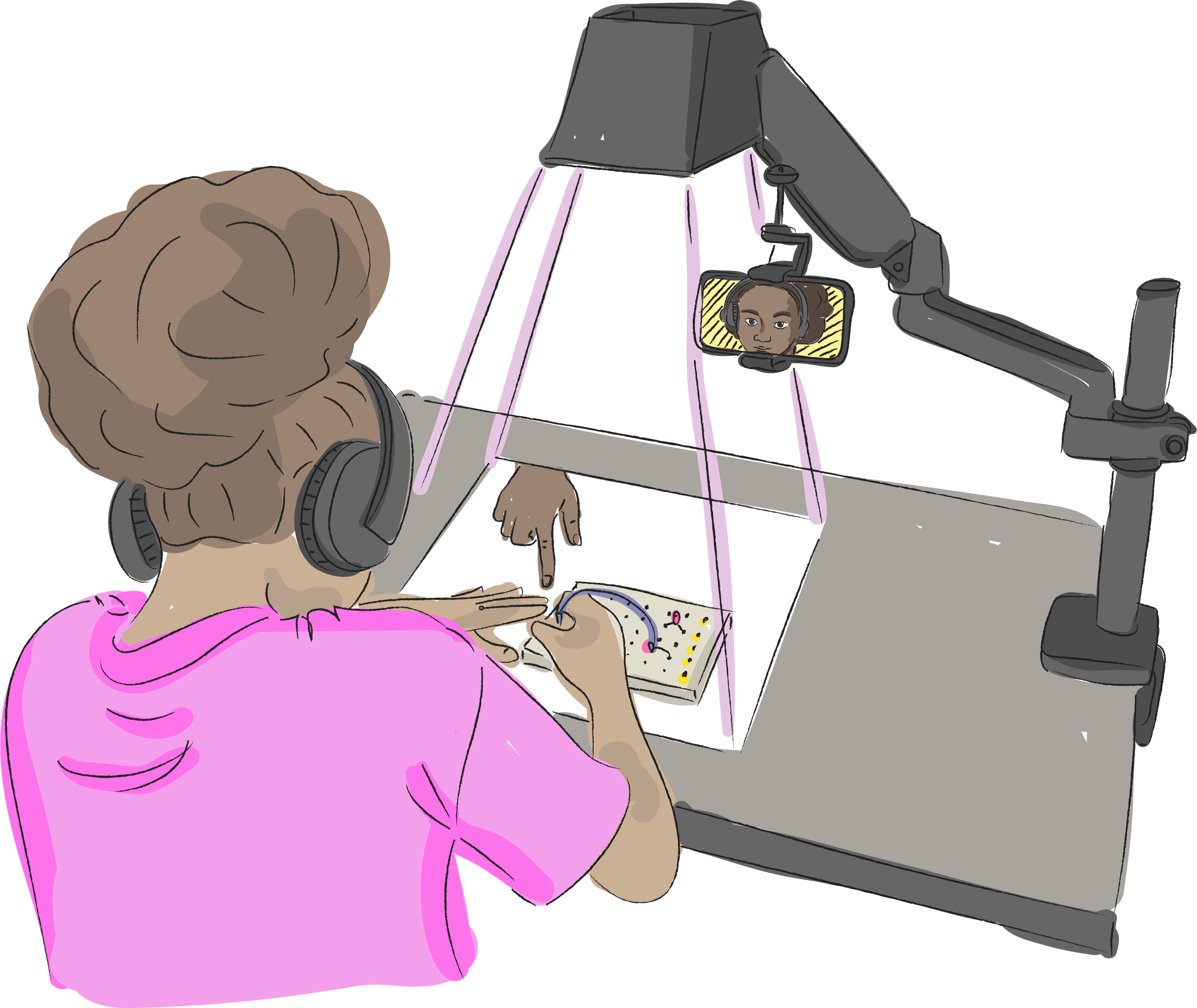
The REACH projector (Remote Embodiment for Augmented Collaborative Help) is a two-way communication device that uses a camera and projector paired to enable real-time communication and debugging between two spaces.
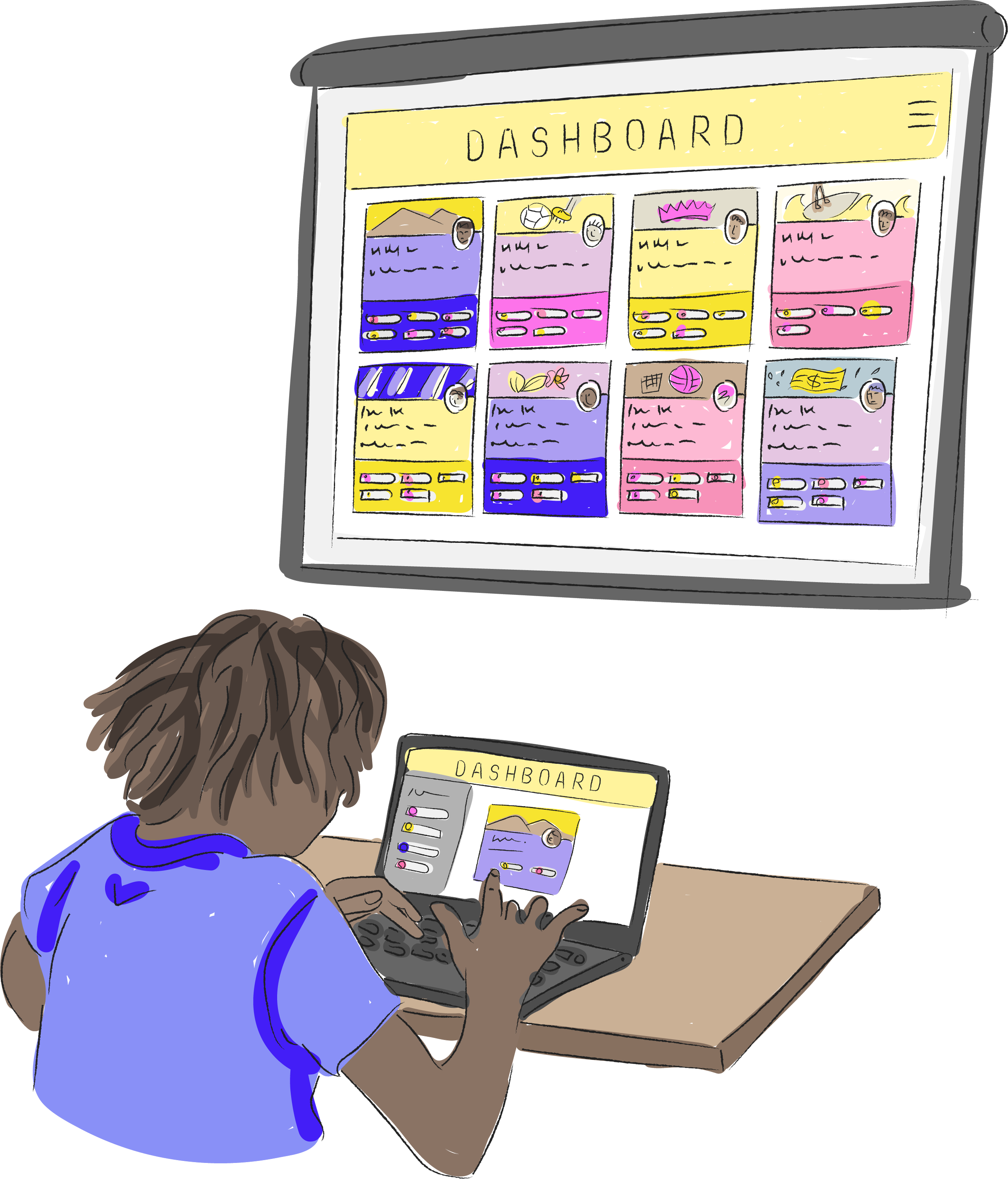
The dashboard is a persistent display in the makerspace that allows students to share their evolving interests and skills in personalized cards with affinity icons. Affinities represent areas students feel connected to, whether or not they are experts, helping foster productive learning opportunities. Interactions with the dashboard are part of the daily curriculum, encouraging students to make updates to their affinities or look into each other's profile at the time of needing support.
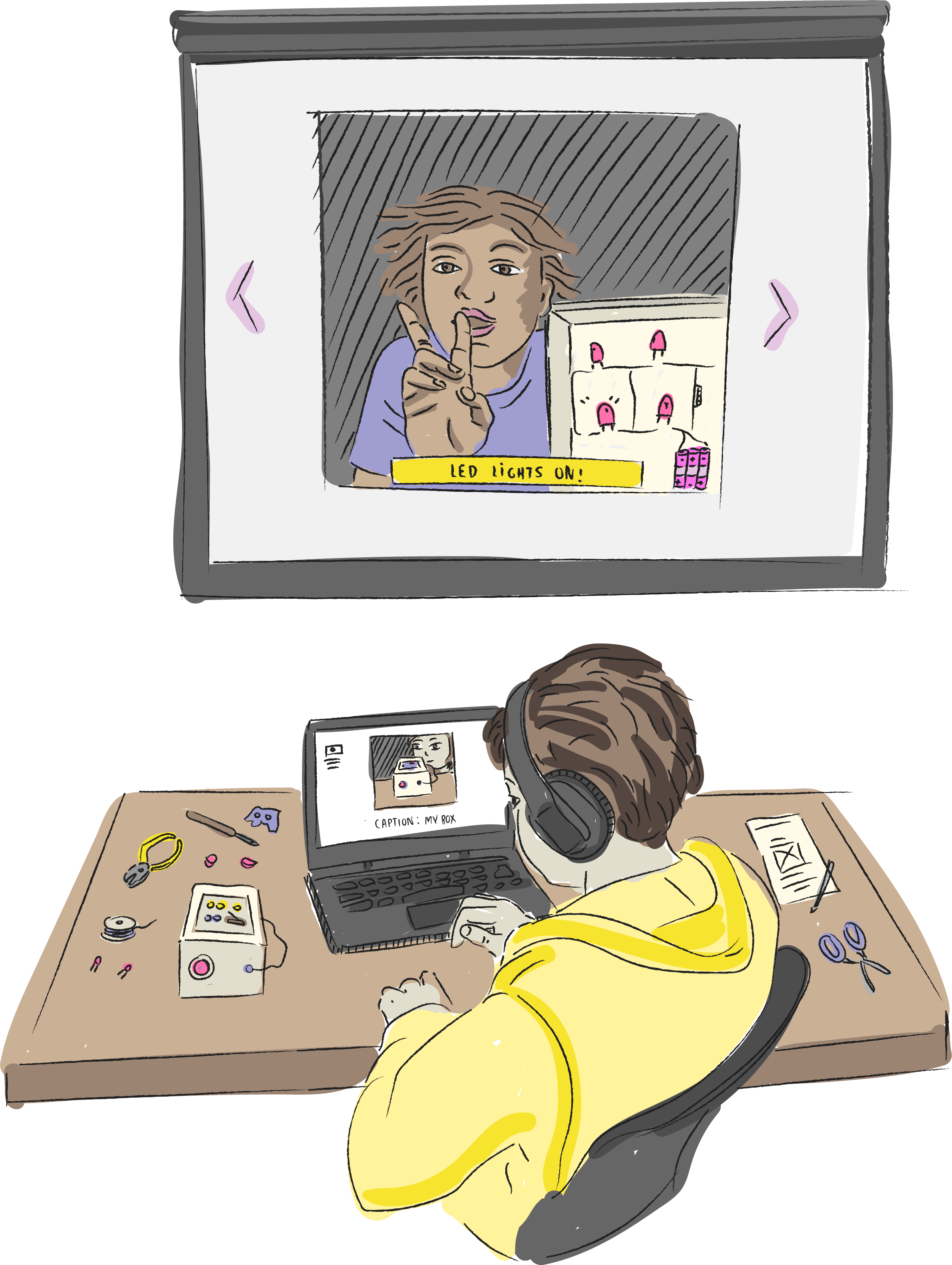
The MIP carousel is displayed along the dashboard to showcase students' processes. Students can capture photos or videos of their work, add a brief caption, and instantly publish them to carousel displays in each makerspace. They can also view each other's updates through their dashboard profiles. Interactions with the carousel are part of the daily curriculum. Students are encouraged to share their progress or challenges to promote collaboration and a sense of community.
Making Knowledge Visible
The REACH aims to allow students to make their knowledge visible and tangible at a distance, allowing embodied collaboration around the artifacts projected by the device.
Building Community
The main goal of the REACH is to facilitate connections between students and with mentors across makerspaces, supporting collaboration, knowledge sharing and collective construction.
Making Knowledge Visible
The visual display of students aims to increase knowledge awareness allowing students to showcase their skills and connect with peers who share similar interests.
Building Community
The display aims to support students to find peers to collaborate with or ask for help within and across makerspaces.
Facilitating Computational Action
The dashboard aims to legitimize students' presence by bringing students' perspectives and values into making practices.
Making Knowledge Visible
The ongoing display of projects aims to help students track progress and learn from each other's processes.
Building Community
By seeing themselves and their projects, this aims to promote a sense of belonging to an extended community of makers and creators.
The CxS Curriculum
It all begins with students' interests and ideas. Maybe they want to build a new video game or reimagine their community's health care system. Maybe they just want to play around with technology. Whatever it is, CxS puts students interests at the center through pedagogical moves designed to make their knowledge and interests visible for themselves and for others in larger communities of makers.
COMPUTATIONAL IDENTITY
The Connected Spaces (C/S) Summer camp curriculum over the years has focused on engaging learners in computing through constructionist maker activities with the goal of supporting learners to develop computational identities, and then inviting them to put those identities in action in a manner that is empowering to them and their communities. This research investigates the impact of activities like mind maps and shark tanks presentations, conversations with community mentors, development of a caring and safe community, scaffolding and support towards personally meaningful projects, and final showcase presentations on their evolving computational identities.
Published Work
- Bawankule, A., & Tissenbaum, M. (2025). Maker Mindset or Making What Matters: Journeys of Persistence Towards Identity-Driven Making. In Proceedings of the 19th International Conference of the Learning Sciences-ICLS 2025, pp. 341-349. International Society of the Learning Sciences.
- Smith, C., Bawankule, A., & Tissenbaum, M. (2025). Connected Spaces: Opportunities for Identity Development in Distributed Maker Communities. In Proceedings of the 19th International Conference of the Learning Sciences-ICLS 2025, pp. 1454-1458. International Society of the Learning Sciences.
- Tabares, S. O., Tissenbaum, M., & Bawankule, A. (2025). Exploring Computational Action: Summer Camp Influence on Computing Attitudes among Middle School Students. In Proceedings of the 19th International Conference of the Learning Sciences-ICLS 2025, pp. 1694-1698. International Society of the Learning Sciences.
- Bawankule, A., Hopping, D., Tissenbaum, M., Weatherspoon, H., & Ruffin, M. (2023). Fostering Maker Identity and Collaboration: Affordances of the Connected Spaces Dashboard in Two Afterschool Makerspaces.
- Bawankule, A., & Tissenbaum, M. (2023, January). Maker identity development: What and how?. In International Conference of the Learning Sciences.
DOCUMENTATION AND HELP FINDING
Over several years and many makerspace implementations, we have iteratively developed tools for learners to document their projects and find other makers for collaboration and mentorship. The Connected Spaces Dashboard, Make-in-Progress (MiP), and REACH are tools for peripheral awareness, maker identity development, the promotion of help seeking behavior, and collaboration. Student profiles and cycling images, videos, and captions on large ambient screens across several spaces make often hidden aspects of the making process visible to the maker community. Affinities, developed in conversation with students, enable learners to represent their interests, passions, and expertise. AI features analyze multimodal data to provide support for students and facilitators in dynamic maker environments.
Published Work
- Danzig, B., Correa, I., & Holbert, N. (2025). Making Processes Visible in Distributed Maker Communities. Proceedings of the International Conference of the Learning Sciences, 3203-3205. https://doi.org/10.22318/icls2025.891328
- Danzig, B., Semprun, E., Holbert, N., Voorhis, J.K. & Correa, I. (2025). Supporting Constructionist Maker Environments with Multimodal AI. Constructionism Conference Proceedings, 8, 535-537. https://doi.org/10.21240/constr/2025/110.X
- Hopping, D. A., & Tissenbaum, M. (2025). The Connected Spaces Dashboard: Capturing Productive Resistance Through Design Based Research. Proceedings of the International Conference of the Learning Sciences, 2774-2776. https://doi.org/10.22318/icls2025.725749
- Smith, C., & Tissenbaum, M. (2025). REACH: Extending reality for distributed collaborative making. Computers & Education: X Reality, 7, 100111.
- Liu, J., Smith, C. J., & Tissenbaum, M. (2024, November). REACH Projector: A Remote Collaboration Projector-Camera System with an Effective Visual Echo Cancellation Algorithm. In Companion Publication of the 2024 Conference on Computer-Supported Cooperative Work and Social Computing, pp. 175-178.
- Bawankule, A., Hopping, D., Tissenbaum, M., Weatherspoon, H., & Ruffin, M. (2023). Fostering Maker Identity and Collaboration: Affordances of the Connected Spaces Dashboard in Two Afterschool Makerspaces.
- Tissenbaum, M., Holbert, N., Smith, C., Correa, I., Hall, K., Bawankule, A., Danzig, B. (2023). Interactive tools for distributed community building and collaboration in maker education. Proceedings of the 17th International Conference of the Learning Sciences (ICLS 2023). Montreal, Canada: International Society of the Learning Sciences.
- Tissenbaum, M., Smith, C., Bawankule, A., Hopping, D., Holbert, N., Correa, I., Danzig, B., & Zikovitz, D. (2023). Connected Spaces: Technological Infrastructure for Collaborative Debugging at a Distance. In Productive Designs for Successful Failure: Constructionist Perspectives on Supporting Personally Meaningful and Culturally Empowered Learning and Teaching. Proceedings of Constructionism / FabLearn 2023. New York, NY: ETC Press.
- Smith, C., & Tissenbaum. (2023). The REACH System: Boundary Spanning's Support of Distributed Collaborative Making. Proceedings of the Constructionism / FabLearn 2023 Conference. Association for Computing Machinery (ACM).
Connected Spaces Team

Mike Tissenbaum
University of Illinois, Urbana-Champaign

Nathan Holbert
Teachers College, Columbia University

Ashita Bawankule
University of Illinois, Urbana-Champaign

Blake Danzig
Teachers College, Columbia University

David Hopping
University of Illinois, Urbana-Champaign

Emmy Semprun
Teachers College, Columbia University

Santiago Ospina Tabares
University of Illinois, Urbana-Champaign

J Voorhis
Teachers College, Columbia University

Isa Correa
Teachers College, Columbia University

Casey Smith
University of Illinois, Urbana-Champaign
Partners


